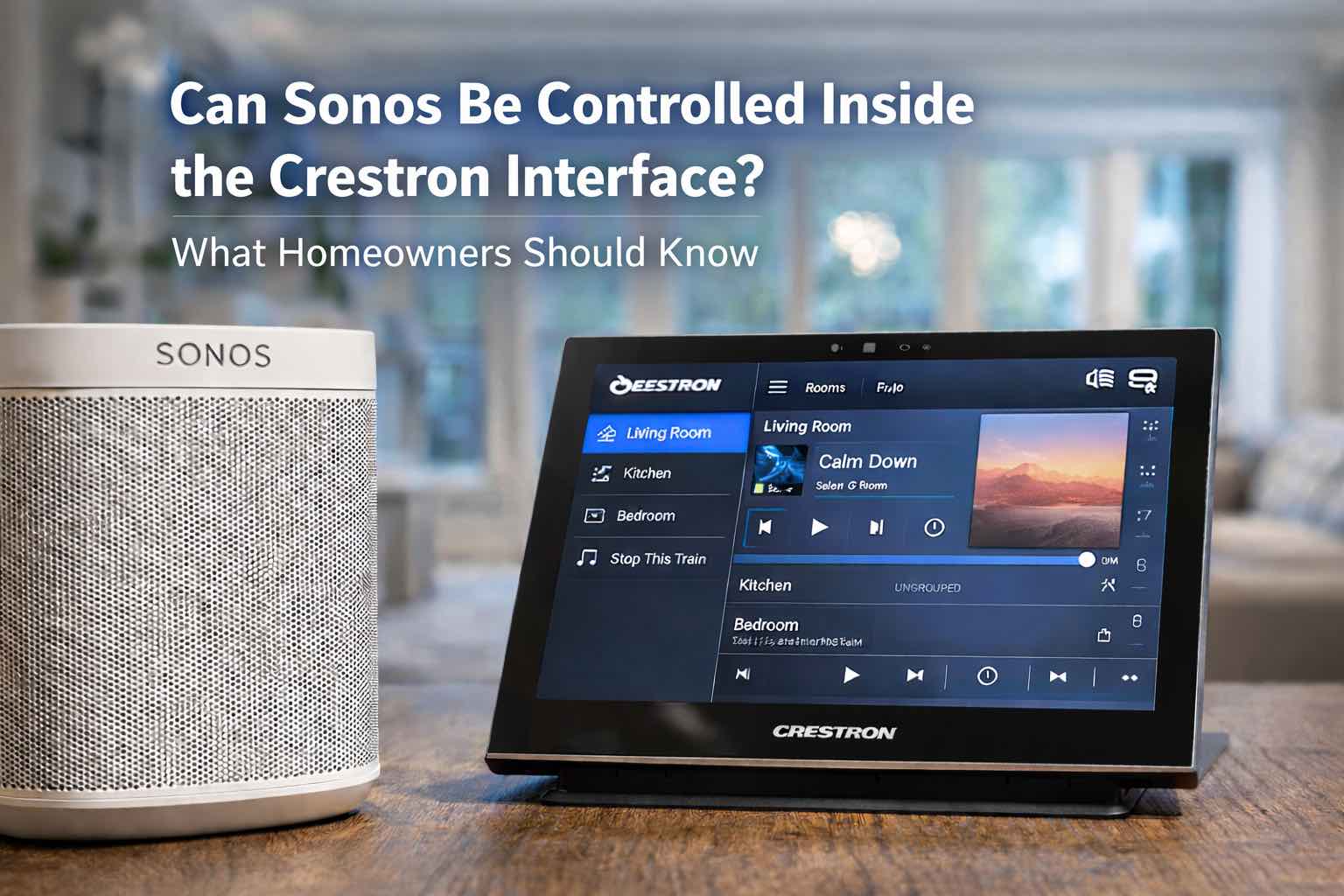
Homeowners choosing whole-home automation often want the best of both worlds: the simplicity of Sonos and the power of Crestron. A common question we hear is whether Sonos can be controlled directly inside the Crestron interface, and if so, how that experience actually works day to day.
The good news is yes, Sonos can be controlled through Crestron. But understanding how that control works—and what it’s best used for—helps homeowners make smarter decisions about their audio system.
How Sonos Control Works Inside Crestron
Sonos integrates with Crestron in a way that allows basic and everyday audio control directly from Crestron touchscreens, handheld remotes, and mobile apps. Instead of jumping between multiple apps, homeowners can manage music as part of their overall home system.
Within the Crestron interface, homeowners can typically control:
- Room or zone selection
- Volume up and down
- Play, pause, and track skipping
- Grouping and ungrouping Sonos zones
- Audio triggers within automation scenes
For most daily listening, this creates a clean and intuitive experience.
What Crestron Adds to the Sonos Experience
Crestron doesn’t replace Sonos, it just makes it better unifying audio with the rest of the home. When Sonos is integrated properly, it becomes part of a larger automation ecosystem instead of a standalone speaker system.
This allows your home to do things like:
- Start music automatically when you enter a room
- Adjust volume when lighting scenes change
- Pause audio when a doorbell rings or a call comes in
- Play specific playlists as part of Morning, Entertaining, or Away scenes
Instead of controlling music separately, it becomes part of how the home behaves.
When You’ll Still Use the Sonos App
Even in a Crestron controlled home, the Sonos app still has a purpose. Most homeowners continue to use it for content focused tasks such as browsing, managing favorites, and adjusting account settings.
A helpful way to think about it:
- Sonos manages content
- Crestron manages control and automation
This balance keeps the system flexible without adding complexity.
Is Sonos a Replacement for Distributed Audio?
Not always, and that’s an important distinction. Sonos works extremely well in Crestron homes, but it isn’t designed to replace every type of audio system.
Sonos is often ideal for:
- Bedrooms and guest rooms
- Secondary listening areas
- Outdoor zones
- Spaces where flexibility is more important than absolute performance
For large homes or primary entertainment areas, a dedicated distributed audio system may still be the better foundation, with Sonos integrated where it makes the most sense.
The Importance of a Strong Network
Both Sonos and Crestron depend on reliable networking. Without a properly designed network, homeowners may experience delays, dropouts, or inconsistent grouping between rooms.
Homes with enterprise-grade networking benefit from:
- Faster response times
- More stable multi-room audio
- Reliable automation scenes
- Better long-term system performance
This is one of the most overlooked—but critical—parts of a successful integration.
New Construction vs Existing Homes
In new construction, Sonos integration can be planned cleanly with proper wiring, speaker placement, and centralized control. In existing homes, Sonos offers flexibility since it can often be added without opening walls or rewiring the entire house.
Both approaches work well when the system is designed intentionally.
What Homeowners Should Consider Before Integrating
Before adding Sonos to a Crestron system, homeowners should consider:
- Which rooms need Sonos versus other audio solutions
- How important app-free control is
- Whether music should be tied to automation scenes
- If the current network can support the system reliably
Answering these questions upfront ensures the system feels cohesive—not patched together.
A Seamless Audio Experience When Designed Correctly
Sonos can absolutely be controlled inside the Crestron interface—and when integrated properly, it provides a smooth, intuitive audio experience that fits naturally into a whole-home automation system. The key is thoughtful planning that balances simplicity, performance, and long-term flexibility.
If you’re considering adding Sonos to a Crestron controlled home, GMI Automation can help design an audio solution that works beautifully today and scales easily for the future.